Looking Up: Understanding the Northern Lights
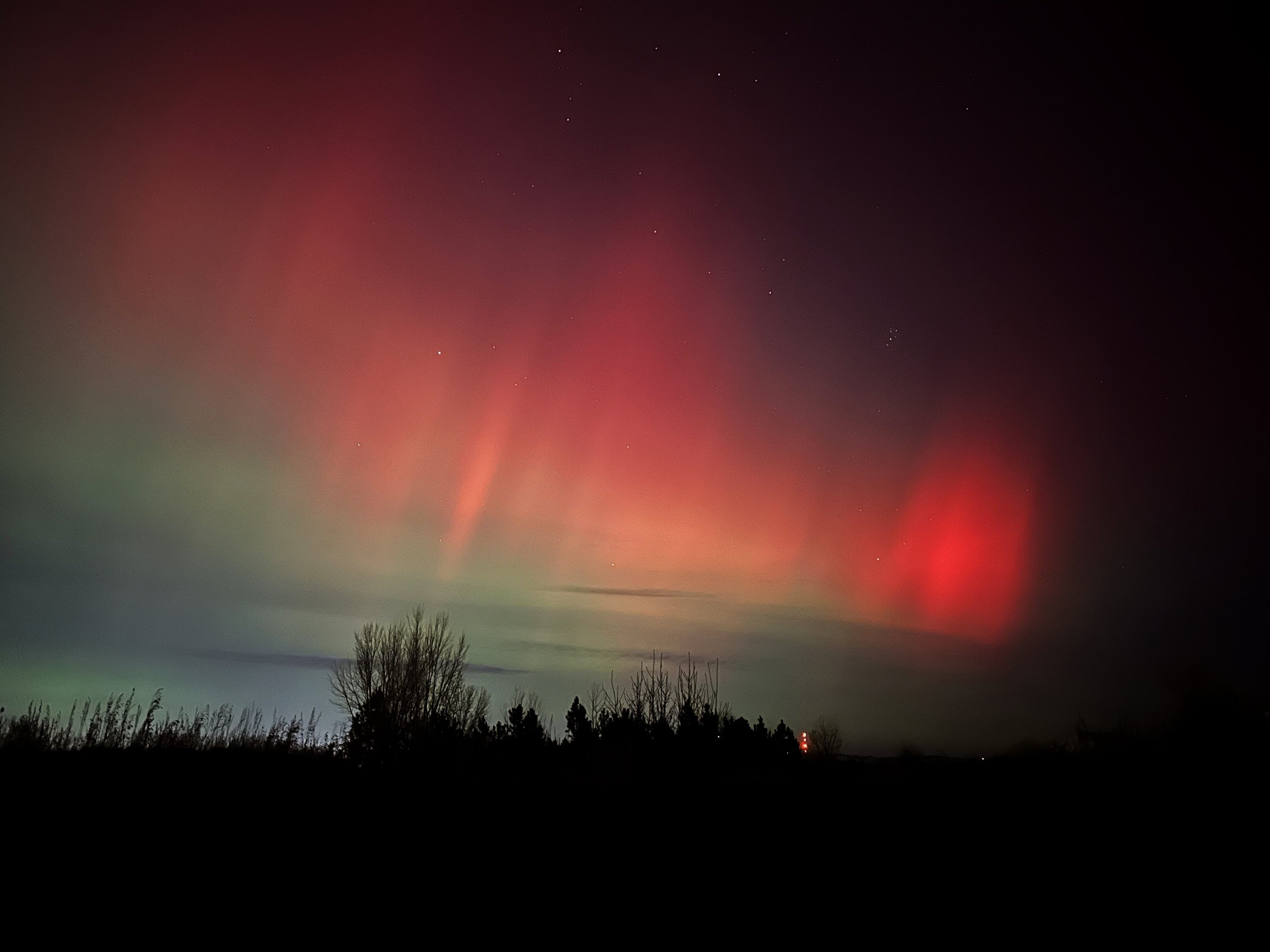
Photo by R. Schmidt (Billings, MT)
As a scientist who spends just as much time looking at the sky as looking at the ground for dinosaurs (or so I’m told), there’s no way I’d pass up a great opportunity to watch one of nature’s greatest light shows, the aurora borealis. Just such a golden opportunity occurred over much of the U.S. back on November 11th, 2025 and was photographed by several of the Elevation Science staff as well. But...what happened to make this possible? What is an aurora? If you’re wondering, here’s your chance to find out.
What is an aurora?
Before I go totally astronomical on you, you’ve seen aurorae before quite a lot; just not in the way you think you have. Have you ever broken a fluorescent light and heard the distinctive pop when the glass breaks and you see a puff of gas? What’s missing from the pieces? If you said a filament, you would be correct.
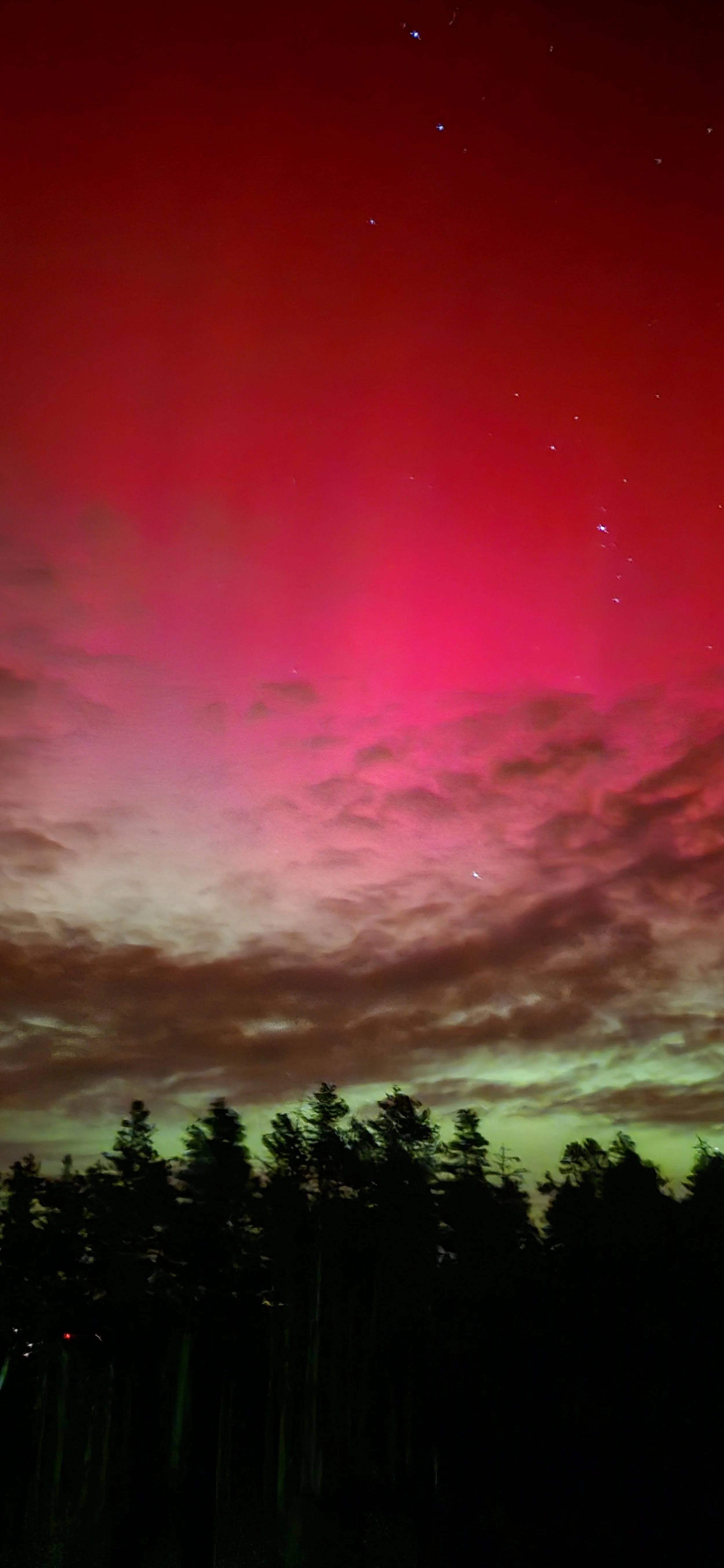
Photo by G. Creasy (Red Lodge, MT)
In a regular incandescent light bulb, there’s a metal filament (usually tungsten) that heats up and glows when electricity passes through it just like most things do when they get hot. Fluorescent light bulbs work on a very different principle, however. A fluorescent bulb is filled with a small amount of mercury vapor and then the pressure inside the tube is lowered significantly to allow energy to more easily travel through the tube. This extremely low pressure is what makes the distinctive “pop” when the bulb is broken. Meanwhile, the inside of the tube is also coated with one or more chemicals known as phosphors that are highly sensitive to ultraviolet light (UV). When electricity is passed through the tube and the mercury, the mercury atoms are excited (ionized) and release UV energy. When this UV energy strikes the phosphor coating on the inside of the bulb, it is absorbed by the phosphors that then release that energy as visible light. Presto...you’ve got a bright light. Colors can be created by changing the phosphors inside the tube that selectively emit visible light in different parts of the visible spectrum (red, orange, blue, etc.).
From time to time, our Sun sends higher than normal amounts of energy towards Earth which is exactly what occurred on November 11th. When this incoming energy strikes the upper atmosphere of the planet at high speed, it is deflected towards the poles by Earth’s magnetic field and then filtered down towards the ground along the magnetic field’s pathways. This energy then strikes oxygen and nitrogen molecules which absorb it thereby exciting the atoms. You’d get excited too if you were hit by something traveling a few million miles per hour! In an attempt to get back to their resting state, the atoms then release the absorbed energy as visible light. Greens and reds are created by oxygen atoms while the shorter wavelengths of purple and blue are created by nitrogen atoms.
What happened on November 11th?
Our nearest star, for all of its benevolence, is a finicky neighbor just as likely to say “get off my lawn” as it is “come over for lunch on the porch” on any given day. I’ve often joked with my students in the past about how the Sun is often depicted with sunglasses and a smiley face in children’s crayon drawings just to then explain all the ways it can cripple our technological infrastructure and negatively impact life on Earth at the drop of a hat. In fact, if you think about what was just discussed, the beauty of an aurora is counterbalanced by the fact it was created by a massive stream of highly dangerous electromagnetic radiation thousands of times the size of the planet smashing into the Earth’s upper atmosphere at over one million mph. Neato...
The Sun goes through an 11 year cycle related to the complexity of its own magnetic field with a distinct period of high activity (called the solar maximum) usually followed by a period of low activity (solar minimum). Right now, the Sun is approaching the maximum phase of Solar Cycle 25 which began in December 2019. It is called Solar Cycle 25 since it is the 25th cycle officially observed by astronomers so we’ve been making observations of our stellar neighbor for awhile now.
On November 9th and 10th, two massive solar flares were observed on the surface of the Sun followed by the release of huge plasma streams that, just by chance, were headed towards Earth at nearly 4 million mph. These streams, known as coronal mass ejections or CMEs, are the energy source needed to light up the planet’s upper atmosphere in dazzling auroral displays. Since we have several Sun-observing satellites on duty 24/7 watching the Sun, we knew they were coming and “geomagnetic storm” watches were posted well in advance. Those of us who receive the alerts grabbed our cameras and lawn chairs and hurried outside on the 11th to wait for the fireworks. They did not disappoint.
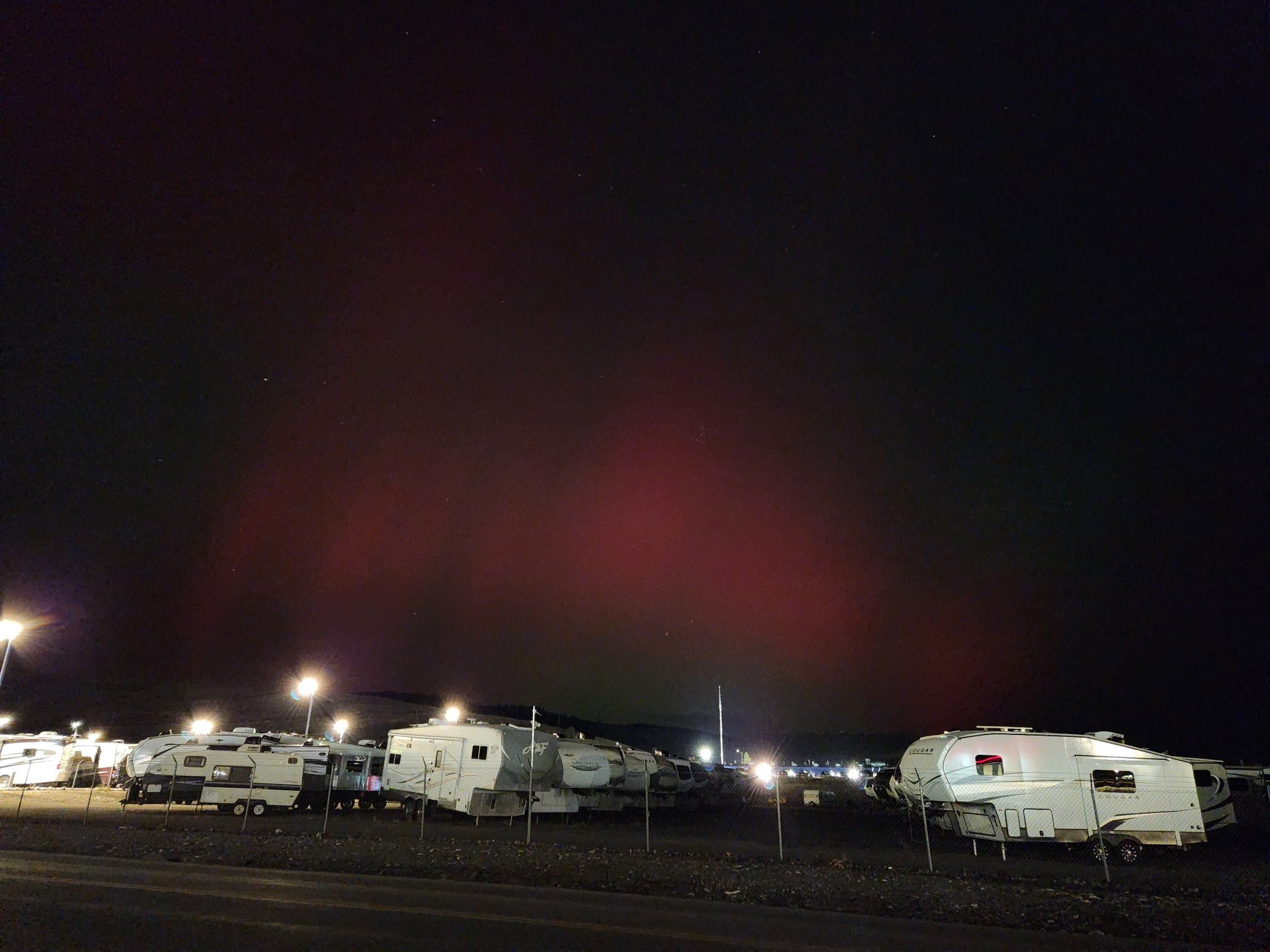
Photo by J. Schein (Missoula, MT)
In Montana, the show was already underway by the time it got dark around 5 PM and covered the entire northern half of the sky. It was especially vigorous to the northeast. Conditions in Billings were perfect for observations and I was able to snap nearly two dozen images. To my southwest at YBRA, much of the show was obscured by Mount Maurice but Greg Creasy was able to capture some of the aurora above the tree line. Meanwhile, Jason Schein got a quick glimpse of it in Missoula while Katie Hunt was even able to see it through regional light pollution near Cincinnati. By the time the multi-CME barrage ended on the 13th, aurorae were seen as far south as Florida. Hopefully you had a chance to watch this event too but if you didn’t, don’t worry! With the Sun entering its most active phase for the next several months, more opportunities are likely so have a camera handy and a nice dark location in mind for your chance to spot one of the planet’s most memorable lightshows.
If you are interested in finding out more information about this phenomenon, NOAA’s Space Weather Prediction Center (https://www.swpc.noaa.gov/) provides real-time data and alerts about the current activity levels of the Sun and alerts about incoming. In addition, www.spaceweather.com also provides near real time updates, aurora alerts and lots of aurora photographs sent in by amateur aurora watchers from all over the world.