From High School Field Participant to Cutting Edge Scientist

Tess Gallagher on the 2024 Field Expedition, holding a sample of Diplodocus skin from the Mother’s Day Site (Credit: Skye Walker / Elevation Science Institute)
New Research on Sauropod Skin Reveals First Evidence of Color Patterning
Red Lodge, MT - Elevation Science Institute is proud to share the remarkable journey of Tess Gallagher, whose cutting-edge research has led to fascinating insights on 150-million year old long-necked, long tailed dinosaurs. Her latest paper, titled “Fossilized pigment structures reveal first evidence of color patterning in sauropod dinosaur skin,” presents a discovery that gives new understanding of what young long necked dinosaurs may have looked like in life.
Gallagher first joined Elevation Science on a field expedition in 2017 as a senior in high school. She loved the experience so much that she returned two years later and, on July 10, 2019, she uncovered a large and exceptionally well preserved patch of juvenile Diplodocus skin at the Mother’s Day Site in Carbon County, Montana. The moment was transformative. Gallagher knew she had found the beginning of a scientific story that she felt compelled to follow.
Her fascination with the mysteries of dinosaur coloration guided her through years of research that became the foundation of her Master's degree work at the University of Bristol. The Mother’s Day Site continues to be excavated by Elevation Science Institute’s paleontologists and public participants every summer, and they hope to find more fossilized skin specimens to support further research.
The new study looks at skin from a young Diplodocus that was preserved for 150 million years. When scientists examined the skin, they found tiny structures called melanosomes. Melanosomes help create color in animals. The team also found rounded structures alongside the melanosomes. Although their unusual form makes it impossible right now to know the exact color of the dinosaur scales, Tess and her co-authors learned that young sauropods could produce many kinds of patterns. This is similar to what birds and mammals can do today, and it helps scientists better understand what these dinosaurs may have looked like when they were alive.
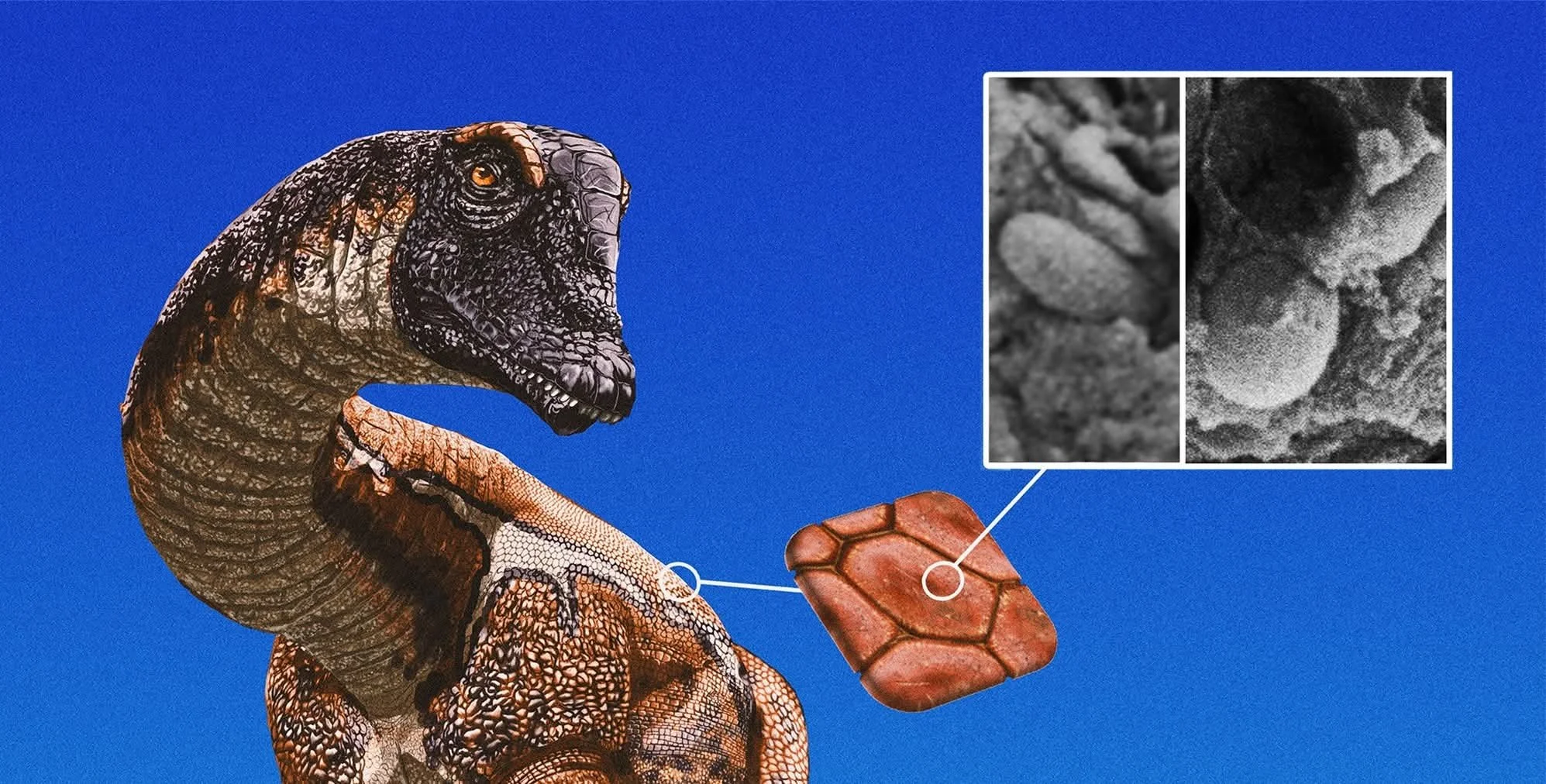
Artwork by Tess Gallagher (2025)
“It has been remarkable to watch Tess grow as a scientist and to see her early experiences with Elevation Science lead to discoveries that change how we understand these ancient animals,” said Jason Schein, Executive Director of Elevation Science Institute. “Tess is passionate and hardworking, and she is a perfect example of what can happen when curious minds are welcomed into real scientific exploration.”
Her story highlights the power of immersive field science to inspire future scientists and spark discoveries that change the way we understand the natural world. Elevation Science Institute invites curious minds of all ages to take part in Paleontology Field Expeditions, where participants work side by side with scientists and contribute to active research projects in Montana.
For more information, the paper, “Fossilized pigment structures reveal first evidence of color patterning in sauropod dinosaur skin”, was published on December 10, 2025 in Royal Society Open Science. The paper is open access and available online.
About Elevation Science Institute (ESI)
At Elevation Science Institute (ESI), discovery isn’t confined to history books or movies. It happens every day, with the public welcomed alongside its scientists every step of the way. Since its founding in 2017, the organization’s programs have invited people to step into the shoes of a paleontologist and uncover some of Earth’s most extraordinary mysteries.
ESI’s flagship Field Expedition program, publicly viewable fossil preparation, and educational initiatives are designed to break down barriers to science, empowering citizen-scientists, families, students, and anyone drawn to adventure to take part in real exploration and research. By connecting people directly to the experience of discovery, Elevation Science aims to foster lasting appreciation for our planet’s natural history and the scientific processes that reveal its ancient stories.